


The right pharmaceutical packaging manufacturer in Australia understands what your regulators and quality team expect from a pack, holds certifications that fit the pack you are buying, keeps your approved text and colours exact from proof to finished carton, and shows you a physical prototype before production starts. Tell us your pack type, the requirements that apply and the documents you need at the start, and we confirm what we can provide within our lead time of ideally 3 to 6 weeks.
Key Takeaways
- Pharmaceutical packaging has three levels, primary, secondary and tertiary, and the first step in choosing a manufacturer is knowing which level you are buying.
- We make secondary and tertiary packaging, which means cartons, rigid boxes, corrugated boxes and pulp moulded inserts, and we say plainly when a part of a pack falls outside what we make.
- In Australia the TGA regulates medicines, and the sponsor and licensed manufacturer carry the responsibility for the finished pack, so a packaging manufacturer supports them with the right materials, accurate print and documents.
- Labelling standards (TGO 91 and TGO 92) and child-resistant packaging requirements (TGO 95) affect the design of the carton, so raise them before the structure is chosen.
- A certificate shows that a system exists, not what it covers, so check the scope of ISO 9001:2015, ISO 13485 and ISO 15378 against the pack you are buying.
- The most serious packaging problems are mix-ups and text errors, so look for a physical prototype, your approval before production, colour checks and clear control of changes.
- Varnish, foil and lamination can block batch and expiry coding, so leave a clear coding area in the artwork and test it on the prototype.
- Our lead time is ideally 3 to 6 weeks, a minimum order quantity applies, and order quantities are best planned around expected label changes.
Choosing a pharmaceutical packaging manufacturer is a different decision from choosing a supplier for ordinary boxes, because a pharmaceutical pack has to carry the right text, protect the product and meet the expectations of Australian regulators on every batch.
Below is a practical guide for pharmaceutical, healthcare and medical device businesses in Australia looking for a pharmaceutical packaging manufacturer. We explain what a manufacturer makes, what the TGA expects of the pack, which certifications matter and what they cover, how mix-ups are prevented, how artwork and print affect cartons, which materials suit which products, why clean room production and co-packing matter, how our process runs, what to send us and the mistakes to avoid. We have produced packaging for more than 40 years, including for pharmaceutical clients, and the projects that run smoothly are the ones where the regulatory requirements reach us at the start.
01. What Does a Pharmaceutical Packaging Manufacturer Make?
Pharmaceutical packaging is grouped into three levels, and the level you need decides which manufacturer, which standards and which questions apply. The diagram below shows the three levels.

| Level | What it is | Examples | Where we fit |
|---|---|---|---|
| Primary | Packaging in direct contact with the medicine | Bottles, vials, ampoules, blister foil, tubes | Specialist primary packaging manufacturers, not what we make |
| Secondary | Holds and presents the primary pack | Printed cartons, rigid boxes for kits and devices, pulp moulded trays and inserts | Rigid box, Pulp moulded insert and Cardboard box |
| Tertiary | Groups and ships the secondary packs | Corrugated shipper cartons and outer cartons | Corrugated box |
Secondary and tertiary packaging carries most of the printed information that a pharmacist, clinician or warehouse team reads, which is why artwork accuracy is such a large part of choosing a manufacturer. Primary packaging materials in direct contact with the medicine, such as glass, rubber, foil and plastic, sit under different standards. A GMP packaging supplier should tell you plainly when part of your pack falls outside what it makes, because a manufacturer that agrees to everything is harder to plan with than one that tells you where its work stops.
Our guide to packaging solutions in Australia shows the full range we make, and the sections below show how each product applies to pharmaceutical and healthcare packs.
02. What Does Australian Regulation Expect From a Pharmaceutical Pack?
In Australia, medicines are regulated by the Therapeutic Goods Administration (TGA) under the Therapeutic Goods Act 1989. The legal responsibility for a medicine and its pack sits with the sponsor and the licensed manufacturer, not with the carton manufacturer. What the carton manufacturer does is supply a pack that lets them meet those obligations. The table sets out the three areas that touch the carton most.
| Area | What it covers | What it means for the carton |
|---|---|---|
| Good manufacturing practice (GMP) | The PIC/S Guide to GMP, which the TGA applies to the manufacture of medicines in Australia. Version PE 009-17 applies from 1 September 2025. | Your quality team sets how printed packaging is received, stored and used, and a manufacturer should be able to work to those rules. |
| Labelling | TGO 91 and TGO 92 set out what must appear on medicine labels, including the name of the medicine, dosage form, active ingredients and quantities, batch number, expiry date and sponsor details. TGO 91 covers prescription and related medicines, and TGO 92 covers non-prescription medicines. The AUST R or AUST L registration number is also required on the label. | The carton is the label surface, so all of this sits on the artwork we print, and the sponsor checks text, layout and legibility against these standards before the artwork reaches us. |
| Child-resistant packaging | TGO 95 sets child-resistant packaging requirements for certain medicines, and the sponsor holds the evidence that the pack complies. | Child resistance applies to the whole package, not only the closure, so raise it before the structure is designed. |
The labelling standards shape the carton layout directly. These examples come from the TGA labelling guidance, and your regulatory team confirms the full list for your medicine.
- Text size and contrast: required information must be at least 1.5 mm high and contrast strongly with its background, with exceptions for very small containers, and active ingredient quantities on the main label of registered medicines have a larger minimum of 3 mm, with exceptions
- Batch number and expiry date: each needs its own prefix above or to the left of it, and a combined prefix such as Lot/Exp is generally not acceptable, so the coding area has to leave room for both
- Medicine name on three sides (TGO 91): the name must appear on at least three non-opposing sides of a prescription medicine carton, which decides how the artwork wraps around the structure
- Dispensing label space (TGO 91): most prescription medicines need a clear area of at least 70 x 30 mm for the pharmacy label, so it has to stay free of design elements
- Machine-readable code (TGO 91): required unless the pack is a starter pack, so it needs to scan reliably on the printed carton
Responsibility stays with the sponsor and the licensed manufacturer, so we do not tell you what your label must say or whether your pack meets TGO 95. We print the text you approve and build the structure you specify, and we ask at the start which of these requirements apply because they shape structure, finishes and artwork. Requirements change, so confirm the current position with the TGA and your regulatory team.
Your regulatory team decides what the pack must say and do. Your packaging manufacturer delivers exactly that, batch after batch, and tells you early if a design choice could get in the way.
03. Which Certifications Should a Pharmaceutical Packaging Manufacturer Hold?
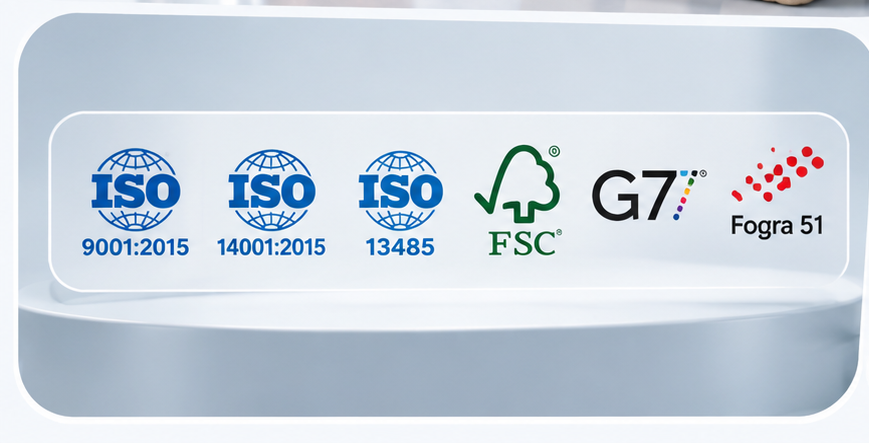
No single certificate makes a manufacturer suitable for pharmaceutical packaging. What matters is whether the certification fits the pack you are buying and what the certificate covers. The table sets out the standards you are most likely to see, what each means for your pack, and which of them we hold. The image below gives an overview of these certifications.
| Standard | What it covers | What it means for your pack | PT Print |
|---|---|---|---|
| ISO 9001:2015 | A quality management system, with documented processes, control of changes and corrective action | The baseline for any manufacturer, and it supports the approval steps and repeatability a pharmaceutical project depends on | Certified |
| ISO 13485 | Quality management for medical devices and their regulatory requirements | Matters most when the pack is for a device, kit or component | Certified |
| ISO 14001:2015 | Environmental management | Useful where your business reports on the environmental performance of its suppliers | Certified |
| FSC | Responsible sourcing of paper and board | Shows where the paper and board come from, and does not replace the quality standards above | Certified |
| G7 and Fogra 51 | Colour standards for offset printing | Keep the colour that tells one strength or variant from another the same across runs and repeat orders | Printed to both |
| ISO 15378 | Primary packaging materials for medicinal products, applying ISO 9001 with reference to GMP | Applies when you are buying materials in direct contact with the medicine, so it does not apply to our cartons, rigid boxes, corrugated boxes or inserts | Not part of what we make |
Read the scope of the certificate, not just the fact that one exists. A certificate names the site and the activities it covers, so ask for a copy and read that part. A manufacturer certified for primary packaging materials is making a different product from one that makes cartons, rigid boxes and inserts that sit outside the medicine, and both can be right for the pack they actually make.
Pharmaceutical companies run their own packaging supplier qualification, and we support it by confirming at the start which documents your quality team needs and what we can provide. Our guide to FSC certified packaging in Australia explains what the FSC mark does and does not cover.
04. How Does a Manufacturer Control Quality and Prevent Mix-Ups?
In pharmaceutical packaging, the most serious problems are not damaged boxes but wrong ones: the wrong text, the wrong strength colour, or cartons from one product mixed with another. GMP guidance treats printed packaging materials with the same care as starting materials, with secure storage, identification of each delivery and checks that quantities reconcile after packing. A manufacturer should be able to show how it controls the same risks on its side. This is what pharmaceutical packaging quality looks like in practice, and at PT Print these controls sit inside our seven stages.
- Approval before production: artwork and text are printed exactly as you approve them, and nothing enters production until you approve the prototype
- A physical prototype: text position, colour, finish and fit are checked on a real sample, not only on a screen proof
- Colour checks during the run: colour is checked against the approved colours through production, so the last carton matches the first
- Control of changes: we agree any change to board, ink, varnish or structure with you before it is made, because a change nobody notices can alter how a pack behaves on your line
GMP guidance also expects separation of products and batches, so cartons from different products do not mix, identification and traceability of each delivery back to a production run, and delivery counts that match the quantity ordered so your packing team can reconcile what was used. How these are met depends on what your quality team requires, so tell us at the specification stage and we confirm how we meet each one.
05. How Do Artwork and Print Standards Affect Pharmaceutical Cartons?
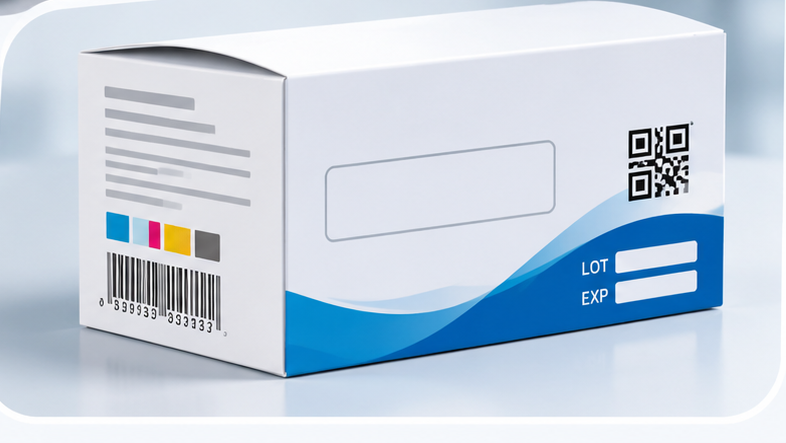
On a pharmaceutical pack the carton is the label, so print quality is a safety matter as well as a design one. The text itself comes from you, because we do not write or approve regulatory wording. What we control is how it is printed, and these points deserve attention at the design stage. The image below shows where each element sits on a carton.
- Legibility and contrast: small type, white type on dark colours and glossy surfaces all reduce readability, so check the text at actual size on the prototype
- Colour consistency: strengths and variants are often told apart by colour, and offset printing to G7 and Fogra 51 with colour control through the run keeps those colours the same across repeat orders
- A clear coding area: batch numbers and expiry dates added on your packing line, by inkjet or embossing, do not hold on varnished, laminated or foil areas, so keep an uncoated area for coding and test it on the prototype
- Barcodes and codes: they need strong contrast and clear space around them, and a finish over a code can affect how it scans, so scan the prototype before approving
- Functional finishes: a matt finish reduces glare when the text is read, and foil and embossing are best kept away from the areas that carry required information
Our offset printing is done on paper and art card, and the same colour standards apply across our cardboard boxes and rigid boxes. Finishes are planned with the coding area and the required text already marked on the dieline, so they do not compete for the same space.
06. Which Materials and Structures Suit Medicines and Medical Devices?
The right material depends on what the pack holds, how it is handled and where it is stored. The table shows how our four products apply to pharmaceutical and healthcare packs.
| Packaging | Typical use | What we confirm |
|---|---|---|
| Rigid box | Medical device kits and healthcare sets that need a firm, presentation grade pack | Board and wrapping paper, and the fit around the device and any inserts |
| Pulp moulded insert | Holds vials, devices or kit components in place, as a fibre based alternative to plastic or foam | Cavity shapes for each item, and the smooth surface of our wet press process |
| Corrugated box | Outer and shipping cartons that carry the printed cartons to your site | Board strength for stacking, pallets and transport |
| Cardboard box | Printed boxes from art card for health and healthcare products | Art card, print and finishes |
Beyond the choice of product, a few structural points decide how well the pack works for a medicine or device. The first is holding the item in place, because a pulp moulded insert is made with a cavity for each vial, device or kit component so that nothing moves in transit, and we confirm the fit at the product test fit stage. If the pack needs tamper evidence, such as a seal that shows the pack has been opened, tell us at the start so it is designed into the structure and checked on the prototype. Cartons for medicines and device kits often carry a leaflet or instruction sheet, so once its folded size is known we allow room for the leaflet or instructions at the design stage.
Moisture and storage also matter, because paper and board take up moisture, so tell us the storage conditions and the environment where the packs will be filled, since both can affect how a pack is built and wrapped for delivery. If the pack has to meet TGO 95, raise child resistance before the structure is chosen, because it changes the design and is checked on the prototype.
Many pharmaceutical businesses also report on packaging sustainability, and a fibre based insert in place of plastic keeps the pack paper based. Our guide to sustainable packaging in Australia covers recyclability and the national benchmarks.
07. Why Do Clean Room Production and Co-Packing Matter?
Paper, board and pulp release fine dust and loose fibre. For most outer cartons that does not matter, but for packaging that sits next to a sterile product, a device or a clean filling area it can. This is where the production environment becomes part of the choice.
Clean room manufacturing is available for projects that need a controlled environment, so tell us the level of cleanliness your product needs and we confirm what we can do before the design is set. Our co-packing service is for projects that need the pack put together as well as made, such as the carton, insert and item assembled as one finished pack. Protection in transit is agreed with you as well, covering wrapping, carton strength and pallet loading, so the packs arrive in the condition your site expects.
08. How Does Our Seven-Stage Process Fit a Pharmaceutical Project?
Our process follows seven stages, and for a pharmaceutical project the regulatory requirements enter at the first one.
Our lead time is ideally 3 to 6 weeks, depending on how quickly the specifications, artwork and approvals are confirmed and whether it is a first run or a repeat order. Having approved text ready at the start protects the timeline. A minimum order quantity applies, and we confirm it at the start once we know the pack.
Plan quantities around label changes. Label text can change, and a carton with old text may no longer be usable, so it helps to set order quantities with your regulatory team’s expected updates in mind. Our custom packaging manufacturing process page shows each stage in more detail.
09. What Should You Send Us to Start a Pharmaceutical Packaging Project?
Your side of the sequence decides how smoothly the project runs. This is what to have ready.
- The pack: the packaging level, box type, dimensions and the item or primary pack going inside, with a sample if you have one
- Requirements that apply: which labelling, child-resistant packaging and other requirements your regulatory team has set for the pack
- Approved text and artwork: finished files with the text already approved, with room kept for the coding area and barcodes
- Documents you need: the certificates and information your quality team asks for, so we can confirm what we provide
- Cleanliness and handling: the environment your product needs and any requirement for co-packing
- Quantity: the number of pieces for each design, planned around expected label changes
- Delivery: the address in Australia and the date you need the packs in hand
- Approver: one person who can sign off the prototype and artwork quickly
10. What Mistakes Should You Avoid When Choosing a Manufacturer?
Most problems come from a gap between what was assumed and what was confirmed, and these are the five that cause the most delay. The first is choosing on certificates alone, because a certificate shows that a system exists but not what it covers or whether it fits your pack, so read the scope. The second is treating every packaging level the same, since primary, secondary and tertiary packaging are made by different manufacturers under different standards. The third is sending artwork late, because text errors found at the prototype stage delay the whole project, so have approved text ready at the start.
The other two come later in the project. The fourth is covering the coding area with a finish, because varnish, foil or lamination over the space for batch and expiry coding can stop the code holding. The fifth is ignoring label change timing, since ordering far beyond what you expect to use leaves you holding cartons with text that may need to change.
11. Why Choose PT Print as Your Pharmaceutical Packaging Manufacturer in Australia?
We supply packaging to pharmaceutical, healthcare and medical device businesses, and we make the whole pack for an order, so structure, print and fit are planned together.
- Over 40 years of experience: we have produced packaging for over four decades, including for pharmaceutical clients, so the choices that shape these projects are ones we have made many times
- Certified quality: ISO 9001:2015, ISO 14001:2015, ISO 13485 and FSC® certified
- Clean room manufacturing and co-packing: available for projects that need a controlled environment or a finished pack assembled
- One manufacturer for the entire pack: rigid box, pulp moulded insert, corrugated box and cardboard box, with the fit of all items checked side by side
- Seven stages process: physical prototype and your approval before production starts
- Reliable colour management: offset printing to the G7 and Fogra 51 colour standards, with colour control throughout the run
12. Conclusion
Choosing a pharmaceutical packaging manufacturer in Australia comes down to fit. Know which packaging level you are buying, read what each certificate covers, expect a physical prototype and your approval before production, and remember that the sponsor and the licensed manufacturer carry the responsibility for the pack while the manufacturer supports them with accurate, consistent work. Tell us your requirements at the start and allow for our lead time of 3 to 6 weeks.
Need packaging for a pharmaceutical or healthcare product?
Tell us your pack type, the requirements that apply and the documents your quality team needs, and we will confirm what we can provide for your order.
Talk to Us About Pharmaceutical PackagingFAQs
What does a pharmaceutical packaging manufacturer do?
A pharmaceutical packaging manufacturer makes the packs that hold, protect and present medicines and medical devices. We make secondary and tertiary packaging, which means printed cartons, rigid boxes, corrugated boxes and pulp moulded inserts, while primary packaging in direct contact with the medicine is made by specialist manufacturers.
Who is responsible for pharmaceutical packaging compliance in Australia?
The sponsor and the licensed manufacturer carry the responsibility for the medicine and its finished pack under TGA requirements. A packaging manufacturer supports them by printing the approved text, building the specified structure and providing the documents their quality team asks for. Please confirm current requirements with the TGA and your regulatory team.
Does a pharmaceutical packaging manufacturer need GMP certification?
GMP is the standard for making medicines, and the TGA applies the PIC/S Guide to GMP in Australia. What a packaging manufacturer needs depends on the pack and on the requirements your quality team sets for suppliers. ISO 9001 and ISO 13485 show a controlled quality system, and ISO 15378 applies to primary packaging materials. Tell us your requirements and we confirm what we can provide.
Which certifications does PT Print hold?
PT Print holds ISO 9001:2015, ISO 14001:2015, ISO 13485 and FSC certification, and prints to the G7 and Fogra 51 colour standards. ISO 15378 applies to primary packaging materials, which are not part of what we make.
Do you offer clean room manufacturing and co-packing?
Yes. We offer clean room manufacturing and a co-packing service for projects that need them. Tell us the level of cleanliness your product needs at the start, and we confirm what we can do before the design is set.
Can you print our approved label text and artwork?
Yes. You supply the approved text and artwork, and we print it exactly as approved on a physical prototype first. We do not write or approve regulatory wording, and any change goes back to you for approval before it is made.
What is the difference between primary, secondary and tertiary pharmaceutical packaging?
Primary packaging is in direct contact with the medicine, such as bottles, vials and blister foil. Secondary packaging holds and presents the primary pack, such as printed cartons, rigid boxes and pulp moulded inserts. Tertiary packaging groups and ships the secondary packs, such as corrugated shipper cartons.
How long does a pharmaceutical packaging order take?
Our lead time is ideally 3 to 6 weeks, depending on how quickly specifications, artwork and approvals are confirmed and whether it is a first run or a repeat order. A minimum order quantity applies, and we confirm it at the start once we know the pack.