

A box packaging manufacturer for bulk production should keep fit, print colour and delivery dates steady across a large run. For Australian bulk orders, what matters most is the range of box types it makes, a clear minimum order and lead time, quality checks through the whole run and a prototype that every box is matched against. We make rigid boxes, cardboard boxes, corrugated boxes and pulp mold inserts, with an ideal lead time of 3 to 6 weeks.
Key Points to Note
- A bulk order is judged as a whole batch, not by the first sample. The final box should match the prototype you approved, so every question about fit, colour and finish needs to be settled in advance.
- We make every layer of the pack, so all the layers can be designed at once and the fit reviewed at the same time.
- A minimum order quantity applies and it varies by product type, with moulded pulp higher than boxes. Tooling is created for every design, so we need the quantity for each design at the start.
- Our lead time is ideally 3 to 6 weeks. A first order needs new tooling, while a repeat order uses the existing tooling and can move much faster. Speed of approval is one of the critical factors.
- We print to the G7 and Fogra 51 colour standards and measure colour throughout production, not just at the beginning.
- Every project follows seven stages, and a product test fit, a physical prototype and your approval come before anything is produced.
- Packing and delivery to Australia are agreed before production. Boxes that fold flat and boxes that are made up travel differently, so the type affects carton counts and space.
- We hold ISO 9001:2015 and ISO 14001:2015 certification, and we confirm which materials on your order are FSC certified, so you know exactly what applies.
Ordering a handful of boxes and ordering them in bulk are two different jobs. In bulk, the same box has to come out the same every time, and the delivery date usually matters for everything else you have planned.
This article explains how bulk production of boxes works. We cover what makes bulk production different from a small run, which box types suit your situation, the role of quantity in a bulk order, the expected lead time, quality control across a large run, and the packing and delivery of boxes. Whether you are considering a box packaging manufacturer in Australia or placing your first bulk order, the same questions apply. We have been making packaging for more than 40 years, and the smoothest bulk orders are the ones where the fit and quantity were agreed before the tooling was made.
01. What Changes When You Order Boxes in Bulk?
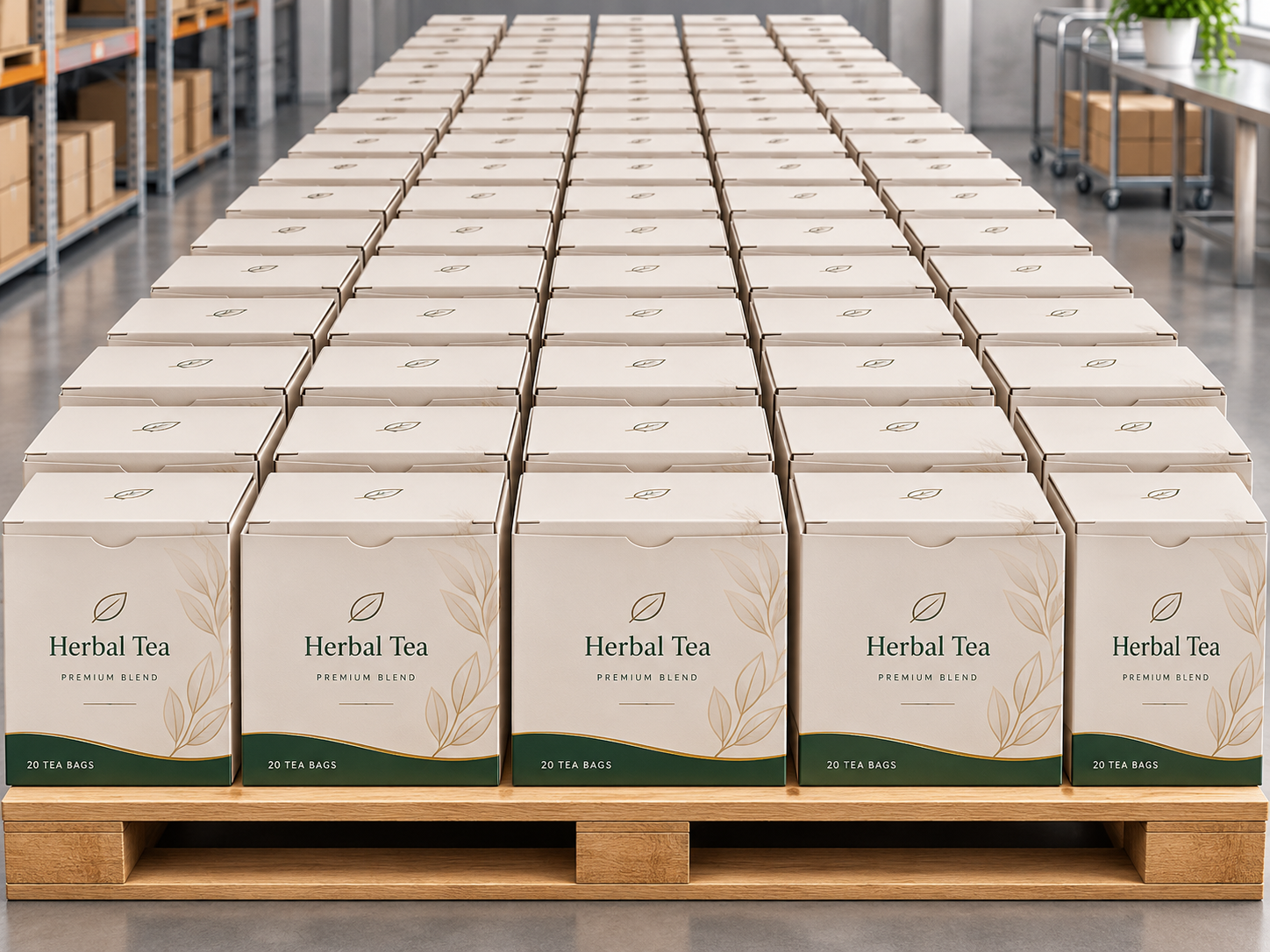
A bulk order is not the same order in larger quantities. The same box has to be produced identically across a long run, and often across several runs, and the delivery date usually matters because of other activities you have scheduled, such as a product launch or a seasonal release. A mistake in a single box is easy to fix. A mistake in a run is far more complicated.
| Factor | Small run | Bulk run |
|---|---|---|
| Consistency | A few boxes can be checked by hand | Needs checks through the whole run, so the last box matches the first |
| Tooling and setup | Built for a small quantity | Built once and carried across the full run, so it has to be right the first time |
| Print colour | One short print run | Colour has to hold steady from start to finish, and again on repeat orders |
| Changes | Easy to absorb | Much harder once tooling is made, so they are settled in the design |
| Packing and delivery | A single carton or two | Carton counts, packing and delivery planned in advance |
This is why a box packaging manufacturer for bulk production has to be judged on more than the first sample. What counts is whether the whole run matches the sample you approved, on time and to the same standard.
02. Which Box Types Does a Manufacturer Need to Handle for Bulk Orders?
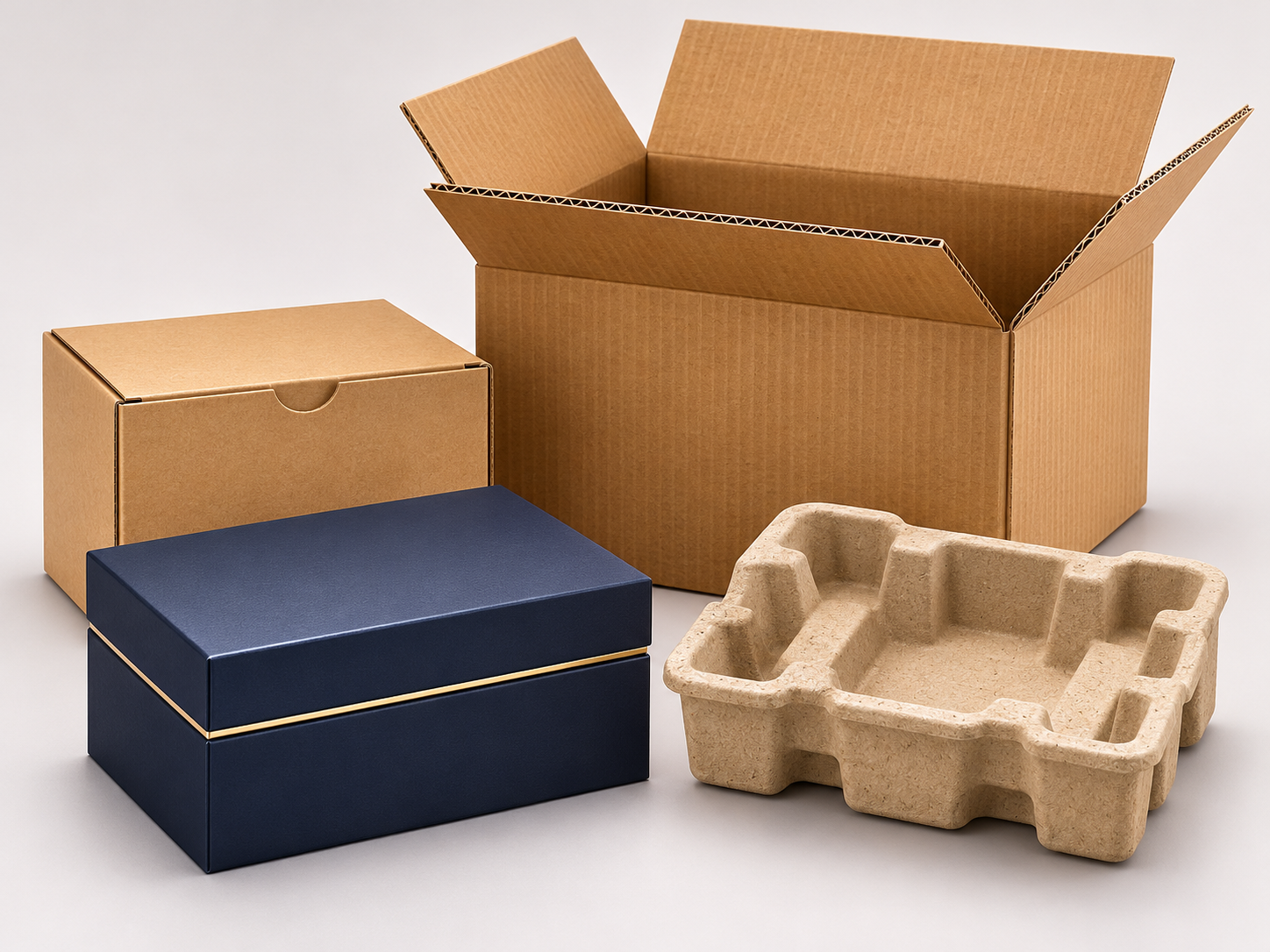
Most bulk projects use more than one box type, because a product needs to be presented, held in place and protected in transit. A manufacturer who makes only one of these can only plan one layer of the pack. This is how the main types fit into a bulk order.
| Box | Best for | What to know in bulk |
|---|---|---|
| rigid box | Premium products, gift sets and presentation packs, including wine boxes | Made up and finished to a high standard, so it takes more space to ship than a flat box |
| cardboard box | Lighter products such as skincare, and accessory sets | Made from art card without a fixed structure, and it usually ships flat |
| corrugated box | Shipping cartons, export packs and master cartons | The outer carton that protects the finished pack through stacking and handling |
| pulp mold insert | Holding a product or bottle in place inside the box | Tooling is built for each design, so the quantity for each design matters |
When one company makes all four, the pieces are planned together. The insert sets the inner dimensions, the box is sized to the insert, and the carton is sized to the box. That is what a custom packaging manufacturer should offer on a bulk order: one set of dimensions that all the layers agree on, checked side by side before production starts. You can see the full range on our packaging solutions page.
03. What Capability Requirements Are Most Important for a High Volume Run?
Capability is usually the first thing on any team checklist. Rather than asking how many machines a manufacturing facility owns, it is more useful to ask whether it can take one design all the way from prototype to the final box. These are the capabilities that matter most for a high volume packaging manufacturer, and what each one means for you.
- Box making capability across types: rigid, cardboard, and corrugated boxes from one manufacturing facility.
- Colour standards in offset printing: we use G7 and Fogra 51 colour standards, which is how we keep colours consistent throughout the printing run and repeat runs.
- Finishes: finishes applied to a rigid box such as foil stamping, embossing and spot UV are defined in the artwork during the design stage, so that every finish ends up right where the design requires it.
- Tooling for moulded pulp: forming, hot press and trimming tooling created for each design, which ensures that inserts are consistent throughout production. We use wet press pulp with a smooth and refined surface.
- Prototyping: a product test fit and a physical prototype before tooling and production, so any issues are detected early, while they are easy to correct.
- Quality Management System: we have ISO 9001:2015 certification that includes how the quality management system is set up throughout the process.
A manufacturer can seem to be doing everything right and still struggle with a bulk order if even one of these is missing, because the problem usually shows up during production, when it is hardest to solve. That is why we settle all of them at the prototype stage, before production begins.
04. How Do Quantity and Minimum Order Quantity Work?
Quantity is the first number we ask for, because it shapes the tooling, the setup and the plan for the run. A minimum order quantity applies, and it differs by product type. Boxes have a lower minimum, and moulded pulp has a higher one, because the tooling for a pulp insert is built for one design and is only worth building for a run of the right size.
| What decides the minimum | Why it matters |
|---|---|
| Tooling built for each design | Dies and moulds are made for one design, so the minimum is counted for each design and not across a whole range |
| Setup for printing and finishing | A run has to be large enough to make the setup worthwhile, and to hold colour steady through the run |
| Product type | Moulded pulp has a higher minimum than boxes, and each box type has its own |
| How many designs are in the order | A range of designs is planned as separate quantities, so tell us the quantity for each one |
The most useful thing you can do is give us the expected quantity for each design at the start, together with how many designs are in the range. We then tell you how the minimum applies to your project and plan the tooling and the run around it. For repeat orders, the existing tooling is reused, so the plan is much simpler.
05. What Lead Time Should You Expect for a Bulk Order?
Our lead time is ideally 3 to 6 weeks. Within that range, a few things decide where a project lands, and most of them are in your hands.
| Factor | What it affects | What helps |
|---|---|---|
| How quickly specifications and design are confirmed | The start of tooling and production | Sending the product, dimensions, box type and artwork together at the start |
| First run or repeat order | Whether new tooling has to be built | A repeat order reuses existing tooling, so it can move faster |
| Speed of prototype approval | When production is allowed to begin | Naming one person who can approve quickly |
| Finishes and structure | The number of steps in production | Settling the finishes in the design stage, not after the prototype |
| Delivery to Australia | The date the boxes reach you | Confirming the delivery address and the date you need them at the start |
If your boxes are tied to a date, such as a product launch or a seasonal release, work backwards from that date and leave room for the prototype and your approval. The time that runs out most often is not the production time. It is the time between the first sample and the approval, so we recommend deciding who approves it before the project starts.
06. How Is Quality Controlled Across a Large Production Run?
On a bulk order, quality control is about staying the same from the first box to the last. The reference for the whole run is the prototype you approved, and every check compares the production boxes against it. These are the checks we run through the process.
| Check | When | What it compares |
|---|---|---|
| Fit | At the prototype stage | The real product, or its dimensions, against the box and insert |
| Print colour | Through the production run | Printed boxes against the approved colour, not only at the start of the run |
| Dimensions and structure | During production | Size, edges, corners and construction against the approved design |
| Finishes | During production | Foil, embossing and spot UV in the position the artwork shows |
| Moulded pulp parts | During production | Wall consistency, edges and dryness against the prototype |
| Packing and counts | Before delivery | Carton counts and packing against what was agreed at the start |
The check that most often decides whether a large run goes well is the colour check through the run. Colour can drift slowly, so checking only at the start is not enough. We check during the run, which is what lets a repeat order match the one before it. Our ISO 9001:2015 certification covers the quality management behind these checks.
07. How Does Our Seven Stage Process Work for a Bulk Order?
Every project we make moves through the same seven stages. For a bulk order, the early stages carry the most weight, because they decide whether the whole run is right.
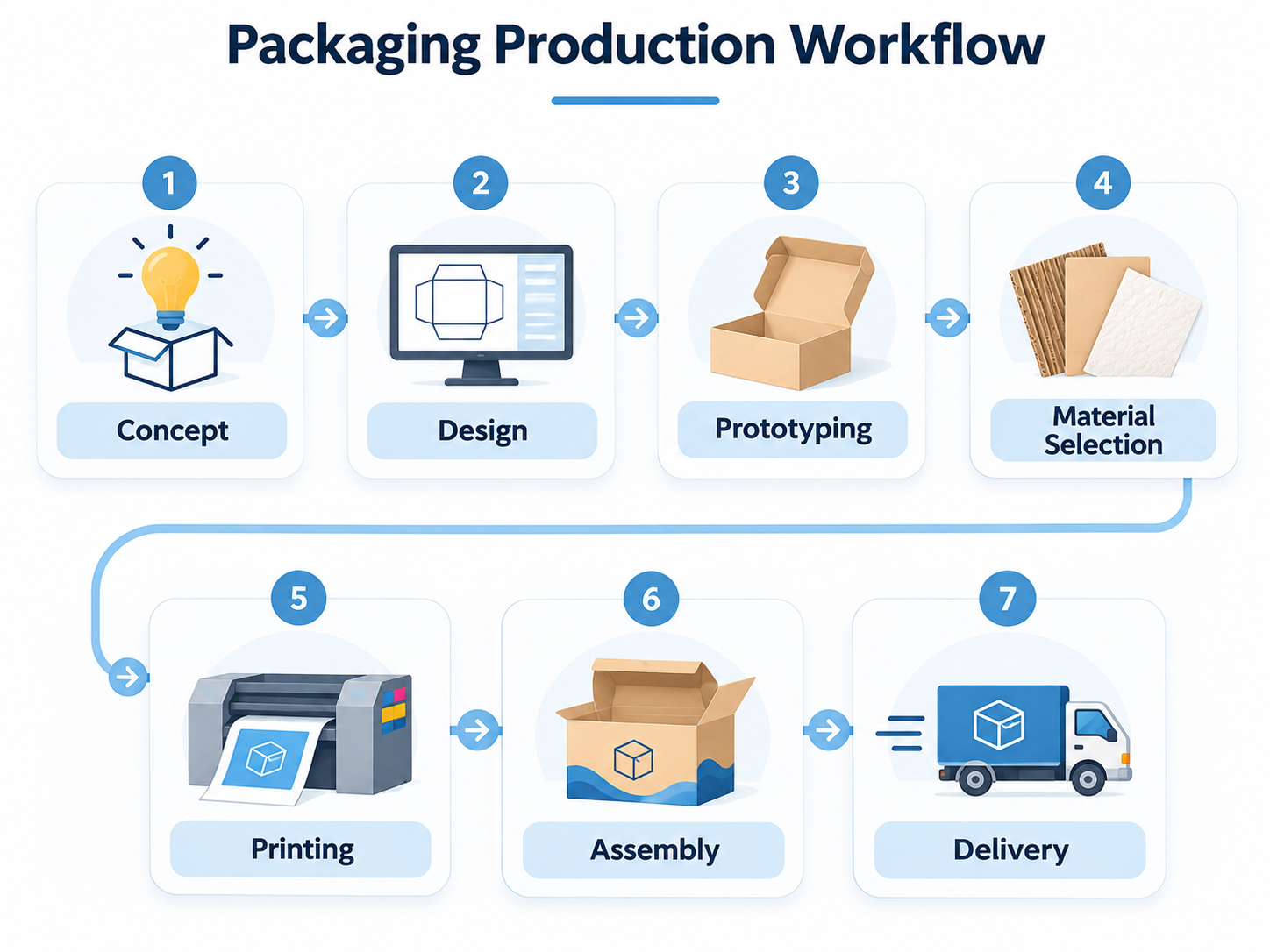
The prototype matters even more on a large order than at any other point, because it is the last opportunity to make changes. Once the prototype is approved, a change to the design or the artwork means changing the tooling or the print setup. For a detailed explanation of each stage across all our products, visit our guide to the custom packaging manufacturing process.
08. How Are Bulk Boxes Packed and Delivered to Australia?
Packing and delivery are decided before production, not after it. Different box types travel differently, which affects the number of cartons required, the volume and the way the boxes are packed. Corrugated and cardboard boxes usually travel flat packed, while rigid boxes are preassembled and take up more volume.
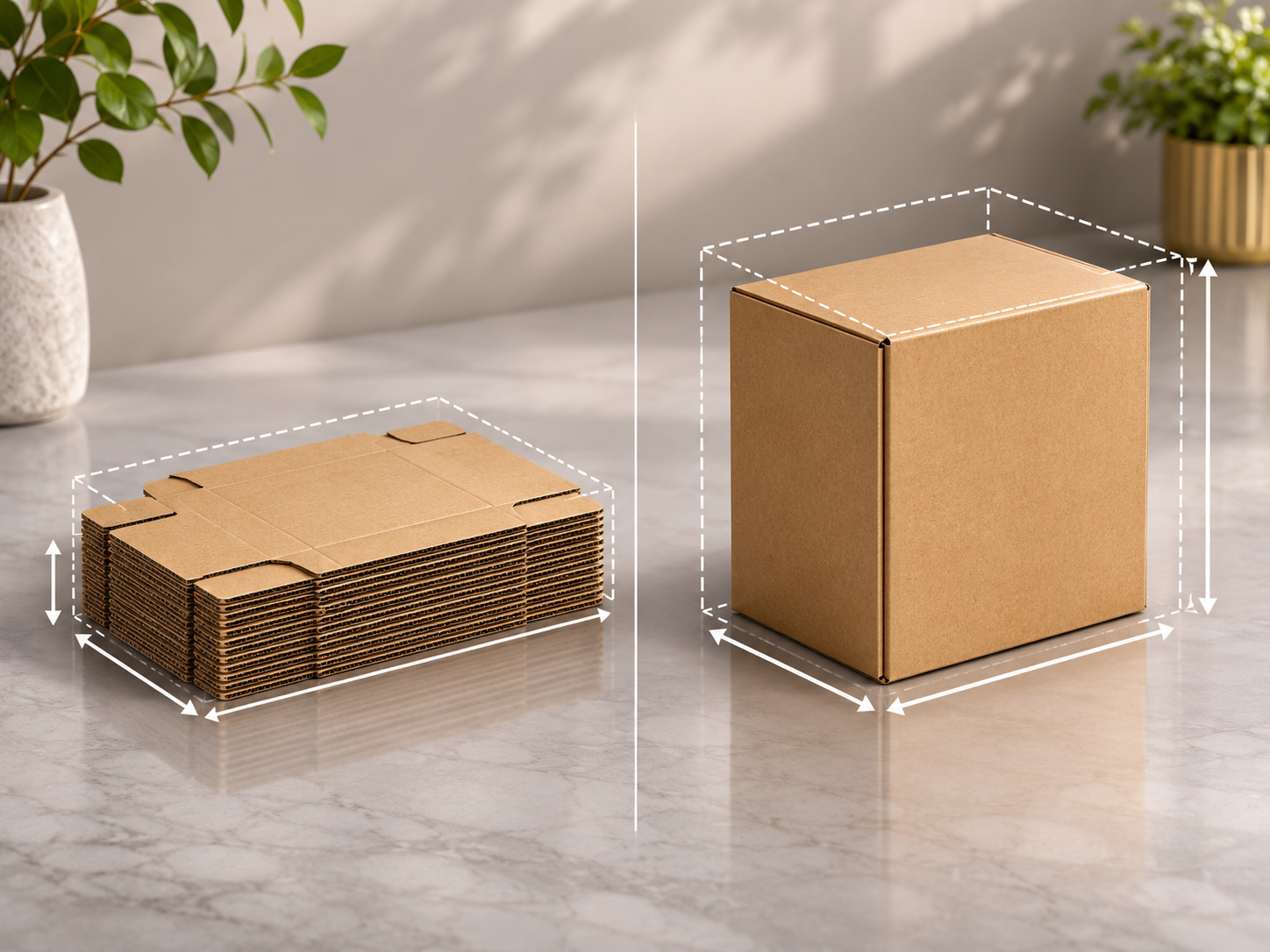
Before production starts, we agree with you how the boxes are packed and counted, the delivery address in Australia and the date you need them. Finished boxes are packed for transport so they keep their shape on the way to you. Once the boxes arrive, store them somewhere dry, because paper and board take up moisture, and moulded pulp inserts in particular should be kept dry until use. If you tell us where the boxes will be stored and how they will be used, we can plan the packing to suit.
09. What Certifications and Sustainability Options Are Available?
Many Australian brands ask about this early, and it helps to be clear about what a claim actually covers. We hold ISO 9001:2015 for quality management and ISO 14001:2015 for environmental management. If FSC certified paper matters for your boxes, tell us at the specification stage so we can confirm which materials on your order are certified. You can read more in our guide to FSC certified packaging, and on our page about sustainable packaging in Australia.
If your pack will carry the Australasian Recycling Label, its recyclability is assessed with APCO's PREP tool, which looks at how a pack is collected, sorted and reprocessed in Australia. Tell us early if this applies to your project, so we can talk through the materials and the structure before the design is fixed. Moulded pulp is fibre based, so it can go into paper recycling where those facilities exist, but collection rules differ from place to place, so check what is accepted in the market where the packaging will be used.
10. What Should You Send Us to Plan a Bulk Order?
Your side of the sequence decides how quickly we can start. This is what to have ready.
- The product or its dimensions: the real product or a sample sent to us, so the test fit is done on the actual item and not on a data sheet.
- The box type: a rigid box, a cardboard box, a corrugated carton or a combination, and how the pack should open.
- Artwork and finishes: your artwork or a brief for our design team, and any finishes such as foil stamping, embossing or spot UV.
- Quantity for each design: how many designs are in the order and the quantity for each one, so we can tell you how the minimum applies.
- Inserts: whether a pulp mold insert is needed to hold the product in place, and any logo to be built into the tooling.
- Delivery: the delivery address in Australia and the date you need the boxes.
- Storage: where the boxes will be kept before use, so we can plan the packing and tell you if humidity is a concern.
- One approver: one person who can sign off the prototype quickly, since approval speed is one of the main factors in the timeline.
11. What Slows Down a Bulk Box Order, and How Is It Avoided?
Most delays on a bulk order have a recognisable cause, and most can be avoided at the start. This table shows the ones we see most often.
| What slows the order | Why it matters in bulk | How it is avoided |
|---|---|---|
| Late prototype approval | Production cannot start until the prototype is signed off | Naming one approver and reviewing the prototype as soon as it arrives |
| Artwork changes after tooling | A change to the structure or logo means altering or remaking the tooling | Settling the artwork, the finishes and any embossing in the design stage |
| Unclear quantity for each design | Tooling and the minimum are planned for each design | Giving the quantity for each design at the start |
| Choosing the box before the fit | A box that does not fit the product has to be redesigned | Starting from the product test fit |
| Finishes not seen on a prototype | A finish that does not look as expected is found too late | Checking foil, embossing and spot UV on the prototype |
| No plan for storage and delivery | Boxes arrive when there is no space or no dry storage | Agreeing packing, delivery and storage before production |
None of these needs technical knowledge on your side. They need the right information early, and a prototype that you hold and approve before anything goes into production.
12. Why Choose PT Print as Your Box Packaging Manufacturer in Australia?
We make the whole pack for an order, so the box, the insert and the carton are planned together. As a box packaging manufacturer for Australian brands and a packaging supplier to Australia for bulk orders, we work from your real product, not from a catalogue size.
- 40 years of experience: we have made packaging for over four decades, so the decisions that decide a bulk run are ones we have made many times.
- One manufacturer for the whole pack: rigid box, pulp mold insert, corrugated box and cardboard box, with the fit of every piece checked side by side.
- A set seven stage process: a product test fit, a physical prototype and your approval come before anything is produced.
- Colour that holds across the run: we print to the G7 and Fogra 51 colour standards and check colour through the run.
- Certified quality: we hold ISO 9001:2015 and ISO 14001:2015 certification.
- A clear lead time: ideally 3 to 6 weeks, confirmed with you at the start.
13. Conclusion
Choosing a box packaging manufacturer for bulk production comes down to whether the whole run will match the prototype you approve, on time. Look at the box types the manufacturer makes, how it handles quantity and the minimum order, how clear the lead time is, how colour and quality are checked through the run, and how the boxes are packed and delivered. Send us your product, the box type, your artwork and the quantity for each design, and allow for our ideal lead time of 3 to 6 weeks. If you are looking for a box packaging manufacturer in Australia, we would be glad to start with the test fit.
Planning a bulk box order for Australia?
Send us your product, the box type and the quantity for each design, and we will take you through the test fit and prototype before anything goes into production.
Talk to Us About Bulk Box ProductionFAQs
How do I choose a box packaging manufacturer for bulk production in Australia?
Look for a manufacturer that makes the box types you need, shows you a physical prototype before production, checks print colour through the whole run and gives you a clear lead time. At PT Print we make rigid boxes, cardboard boxes, corrugated boxes and pulp mold inserts, and nothing goes into production until you approve the prototype.
What types of boxes can you make for bulk orders?
We make rigid boxes, cardboard boxes and corrugated boxes, and we pair them with pulp mold inserts where a product needs to be held in place. Because one manufacturer makes the whole pack, the fit of every piece can be checked side by side.
What is the minimum order quantity for bulk box production?
A minimum order quantity applies and it differs by product type. Moulded pulp has a higher minimum than our boxes because tooling is built for each design. Tell us your expected volume for each design at the start so we can plan the run.
How long does a bulk box order take?
Our lead time is ideally 3 to 6 weeks, depending on how quickly specifications and design are confirmed and whether it is a first run needing new tooling or a repeat order on tooling that already exists. Delivery to your address in Australia is confirmed at the start.
How do you keep quality consistent across a large production run?
The approved prototype is the reference for the whole run. Print colour is checked through the production run and not only at the start, and the finished boxes are compared against the prototype you signed off. We also hold ISO 9001:2015 certification for quality management.
Can you match colour on repeat orders?
Yes. We print to the G7 and Fogra 51 colour standards and check colour during the run, so the last box matches the first and a repeat order matches the one before it. Keep the approved prototype or sample as your reference for later orders.
Do you deliver to Australia?
Yes. Finished boxes are packed for transport and delivered to your address in Australia, as confirmed at the start of the project. Tell us the delivery address and the date you need the boxes, so we can plan the timeline backwards from it.
Are your boxes FSC certified, and what certifications do you hold?
We hold ISO 9001:2015 and ISO 14001:2015 certification. If FSC certified paper matters for your boxes, tell us at the specification stage so we can confirm which materials on your order are certified.
What do you need from us to start a bulk box order?
We need the product or its dimensions, the box type you want, your artwork or a brief for our design team, any finishes, the quantity for each design, the delivery address and date, and one person who can approve the prototype quickly.