

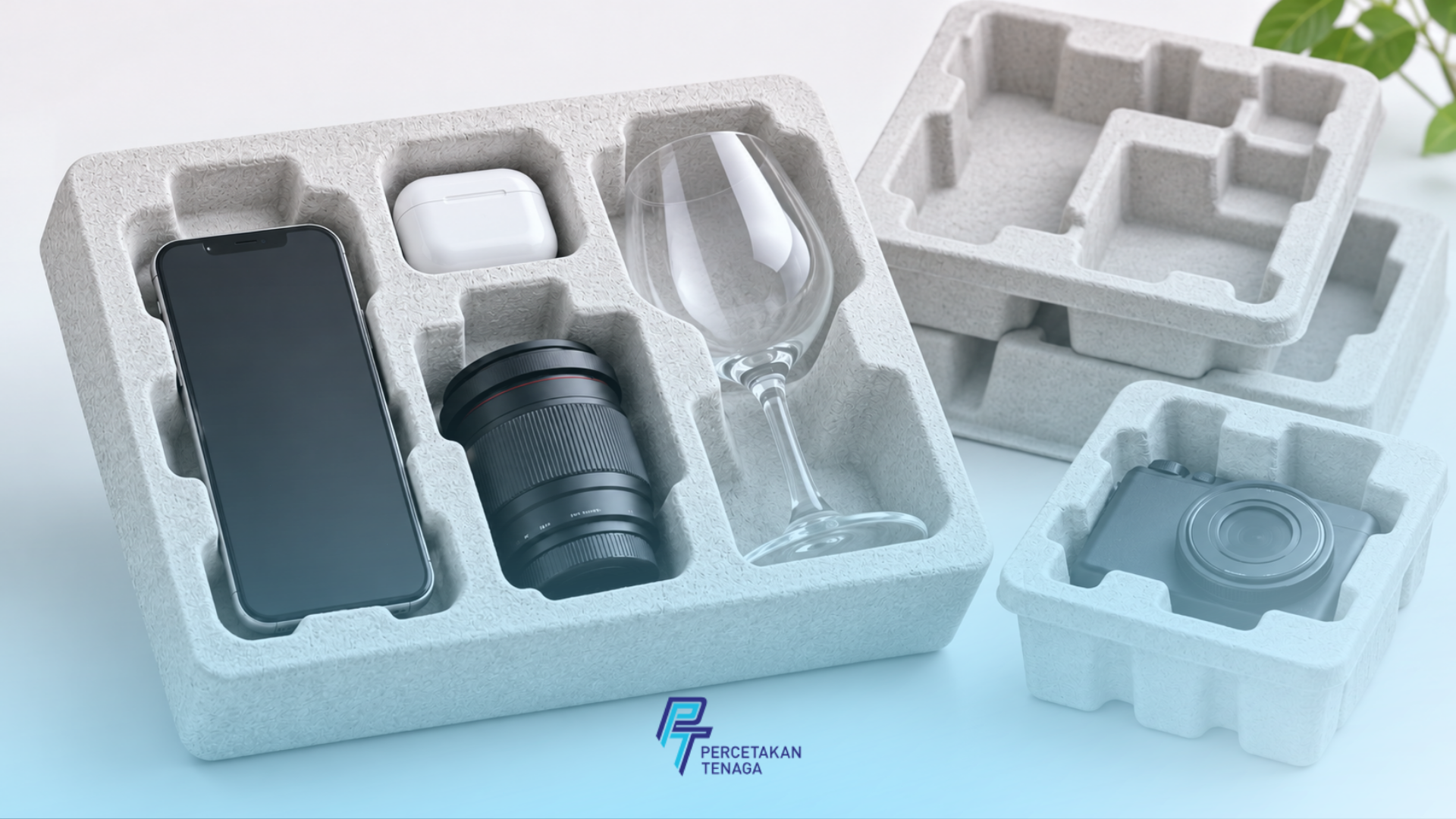
Moulded pulp packaging solutions provide cushioning to protect delicate items. The cavities securely hold the item in place. The walls, ribs and rounded edges also provide shock absorption. The packaging is designed to fit the product, accessories and external packaging. The design is verified using a physical sample before production. We produce wet pressed moulded pulp packaging solutions to protect electronic, beauty, wine and other delicate products for Australian brands.
Key Takeaways
- Protects delicate areas: Provides stability, shock absorption and protects delicate areas (screens, lenses, glass).
- Design depends on product weight, delicate areas, accessory and external packaging.
- Protection: The cavity should fit tightly around the product (with minimal gap) and ensure the product sits on strong sections. The product should not sit on a delicate area (screen/glass neck).
- Shock Absorption: Depends on wall thicknesses, ribs and rounded edges. Thicker packaging does not necessarily mean increased protection. If the walls are too rigid, the shock could be transferred onto the item.
- Electronic items require good cavities to fit the product, accessory pockets and a smooth surface from wet pressed moulded pulp to delicately fit polished surfaces. Glass, ceramic and beauty items require support at their base and shoulder.
- Although this packaging solution can be used for a variety of items, very heavy items, or items in a humid environment may require additional support from the external packaging. We will advise you early on if this is required.
- Verification: Protection is verified using a physical sample with the actual product. The cavity design, angle of walls and embossed branding will be set once tooling is created. Therefore, these aspects of the design will be decided before production.
- Lead time is ideally 3 to 6 weeks. Minimum order quantities apply. Once we know what part you require we will be able to advise what the minimum order quantity is. To get started please send us the product, accessories, external packaging and quantities.
Moulded pulp packaging is tested at its worst point. This would be when a carton is dropped, stacked or knocked during delivery. Despite being designed weeks ago, the packaging needs to perform correctly at this point in time.
This guide provides information for Australian brands within the electronic, beauty, wine, health care and other industries looking to utilise moulded pulp packaging inserts to protect delicate items. It details what information is needed to design protective packaging, how the cavity, walls and ribs protect items, how electronic items differ from glass and ceramics, when extra support from external packaging is required for moulded pulp, and how protection is verified in a prototype before production.
We have been creating packaging solutions for over 4 decades. This includes rigid box, wet pressed moulded pulp, corrugated and cardboard packaging. This means we can design the packaging solution for both the insert and external packaging to provide full protection for the product. If you wish to know more about production, see our guide on moulded pulp production.
01. What Functions Does a Moulded Pulp Insert Perform?
In order to provide protection, the insert performs multiple functions. Internal packaging is designed to both secure items within the packaging, and also protect them from shock and vibration during transport. (Wikipedia)
| Function | Design Feature |
|---|---|
| Secure item in place | The insert prevents movement of items within the packaging. If items move only slightly within the packaging, this can cause damage. The insert is designed to allow close fitting with a little clearance. It should form a cavity that is shaped to fit the item. |
| Shock and Vibration Protection | Energy from shocks or drops is absorbed in order to reduce the amount of energy acting on the goods. Shock absorption in this context is achieved by deforming the material of the packaging. Raised walls, ribs and support structures allow this between the item and outer box. |
| Protect delicate areas | To prevent loading and contact on sensitive areas including screens, optics, glass necks, ports and print. Provide support to strong areas of the item. Leave clearances/reliefs around delicate areas. |
| Aesthetic | Creates a neat finish. A smooth surface is created using wet pressed tools. Logo can be embossed. Cavities in tool have aesthetic finishing features. |
If the insert is not well designed, then they may not offer the correct protection. If the insert is very stiff, and the product is firmly held within the insert, shocks can be directly transferred to the product. For a balance between all of these functions please consider the following:
02. What Information Is Required to Design an Insert?
To design inserts for a product we generally need the product itself. Often the measurements given in data sheets do not match the actual product. For this reason we must have the product in order to carry out a product fit test. Once we are sure that the product fits within the insert correctly, we can begin designing. Please find the information needed to design inserts for your product below.
| What we need to know | Why it matters for protection |
|---|---|
| Weight and balance | A heavier product needs more support underneath and a stiffer structure. An uneven product, such as a bottle that is heavy at the base, needs the support placed where the weight actually sits. |
| Fragile points | Screens, camera lenses, glass necks, buttons, ports and printed surfaces are kept clear of load. We need to know which parts of the product can take weight and which cannot. |
| Surface and finish | A polished or glossy casing, a printed label or a delicate coating can mark if the insert touches it hard. The smooth wet press surface helps, and contact points are placed carefully. |
| Accessories | Chargers, cables, manuals and spare parts each need their own place, so they do not press on the product or move around the box. |
| The outer box | A rigid box lid, a drawer or a corrugated carton each puts different pressure on the insert. The depth and outline of the insert follow the box. |
| How it travels | Courier parcels, pallets, export containers and shelf display each bring different hazards. Tell us how the pack will be handled, stacked and stored. |
| Storage conditions | Moulded pulp is a fibre material and absorbs humidity from the air. If the product or the warehouse is damp, we plan for it at the start. |
If the product is moist, oily or food related, tell us at the start, because it changes the fibre blend we use.
03. How Does the Cavity Design Protect the Product?
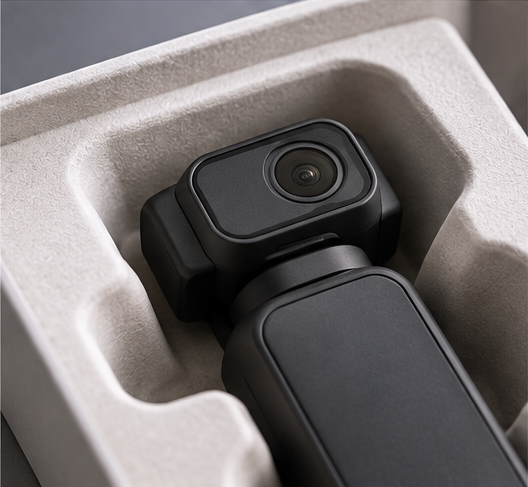
The cavity design determines how well the product is protected. If there is excessive space in the cavity, product movement may occur. If there is too little space, the product may be pinched, scratched, or compressed incorrectly. The cavity has been decided by 5 factors. These have been verified during fit testing.
Product Contour
The cavity mirrors the shape of the product, so the product fits securely in place. Features such as ports, buttons, camera housings and curved features have been considered.
Small Clearance
The product should slot easily in and out of the cavity. The cavity should have just enough room to allow this. If too little clearance is provided, the product may be pinched and marked. If too much clearance is provided, product movement may occur. Correct clearance has been verified during fit testing.
Supports in Strong Areas
The phone is supported by the casing rather than the screen. The bottle is supported by the base and shoulder rather than the neck. Supports have been provided in strong areas of the product. Weak areas have been avoided.
Protection of Delicate Features
Lenses, buttons and glass edges have been positioned in recesses or gaps within the cavity so that they are not being compressed by the closure of the lid or knocking of the carton.
Defined Positioning
Channels for cables and cutouts for leaflets mean that accessories will not move within the product. As everything in the packaging is in a set position, nothing will be loose and so will not move during transport.
04. How Do Walls, Ribs and Corners Absorb Shock?
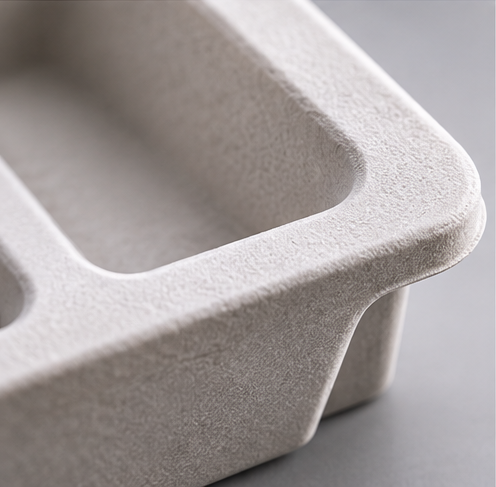
In addition to the material used, the design of the component provides protection. The walls and ribs are designed to compress slightly on impact, to absorb the energy. The design is more important than simply adding more fibres.
| Feature | Purpose |
|---|---|
| Rounded corners | Spread an impact across a wider area. Sharp corners concentrate stress and are where a part is most likely to fail. Every cavity corner and outer edge is rounded. |
| Ribs and raised walls | Stiffen the part without adding much material, and hold the product away from the outer box. They are placed between the product and the box, and around the cavity rim. |
| Uniform thickness | This design prevents thin areas (which could deform easily) and thick areas (which may be too rigid). Uniform thickness is achieved by designing with appropriate dimensions and testing with trial parts to find optimal thickness using times and slurry. |
| Sloped sides | Ensure even formation of sides and easy demoulding. Sides are sloped slightly outwards. Undercuts are absent. |
| Flange | Distributes pressure from closing lid evenly over the insert. This shape is intrinsic to the outer shape of the insert as it will be used with a rigid lid box. |
| Different shapes | In 2024 a study was undertaken into the performance of conical vs pyramidal moulded pulp pins under impact loading. It was found that conical pins performed better as pyramidal pins have sharper edges causing concentrated stress. However, this was a small lab experiment, therefore this should be taken as an example rather than a strict rule for all parts. Rounded shapes are present throughout our designs. |
05. How Do We Design Moulded Pulp Electronics Packaging?
Within electronic packaging, there are many vulnerabilities to damage. These include cracked/scratched screens, scratched shiny casings, and pressed buttons/ports. Accessories may also cause scratching. Moulded pulp inserts are used to protect against all of these vulnerabilities.
| Risk in Electronics Packaging | Solution within insert design |
|---|---|
| Cracked/scratched screen | Device is placed in the insert so that the screen does not come into contact with the insert. Pressure from the lid is applied to the flange rather than the glass. |
| Marked or scuffed casing | The smooth wet press surface sits gently on a polished or glossy finish, where a rougher tray could rub. |
| Camera lenses, buttons and ports | Each raised feature gets a recess or a clear gap, so nothing rests on it. |
| Cables and chargers scratching the product | Accessories have their own compartment, channel or recess, away from the device. |
| Movement in transit | A firm cavity with a small clearance, and ribs between the product and the box. |
Wet pressed inserts provide fine details and a smooth finish. This makes them ideal for electronic products where you would typically get a similar smooth finish to the inner trays on high quality packaging. Rough dry pressed inserts are more suitable for appliances or transport packaging.
Example: Handheld Device
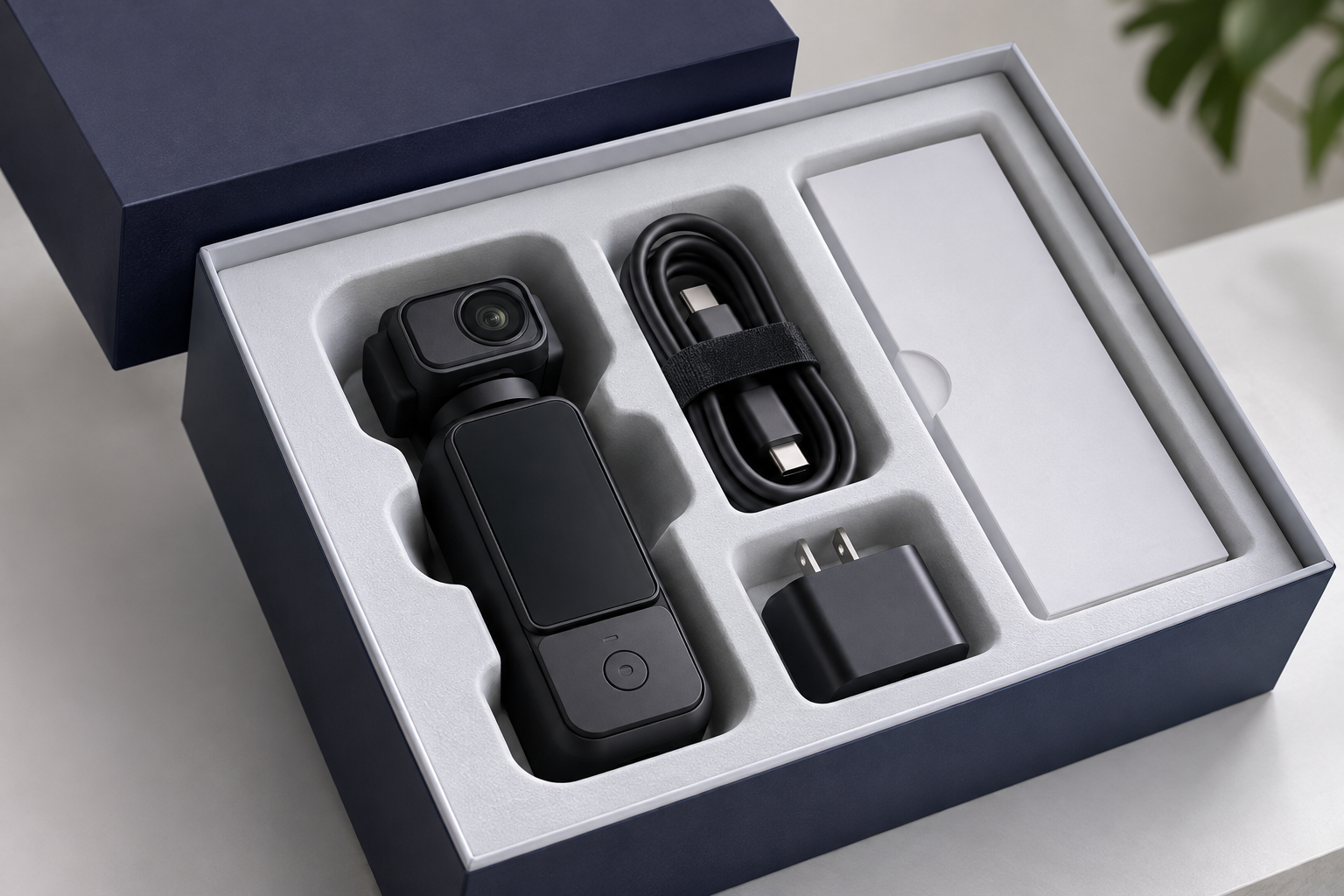
Note: This is an example, not a definitive spec. Each feature has been confirmed on individual prototypes. The cavity has been designed to accept the handheld device. The screen is orientated upright within the insert, so there is space around the screen. Within the cavity there is space to accept the camera housing, cutout to accept the charging cable, and a separate section to hold both the charger and leaflet. There is a rim to allow even insertion of a rigid lid. The rigid lid is applied to the rim rather than the screen. Corners have been rounded and branding has been embossed on the front panel. The space around the product has been confirmed within the trial fit.
Most commonly, rigid boxes are used with moulded pulp inserts. The rigid box provides presentation, and the item is held within the moulded pulp insert. If transport is required, a corrugated box will be used. Further information on packaging for electronic devices can be found here.
06. How Are Inserts Designed for Fragile Items such as Glass & Cosmetic Products?
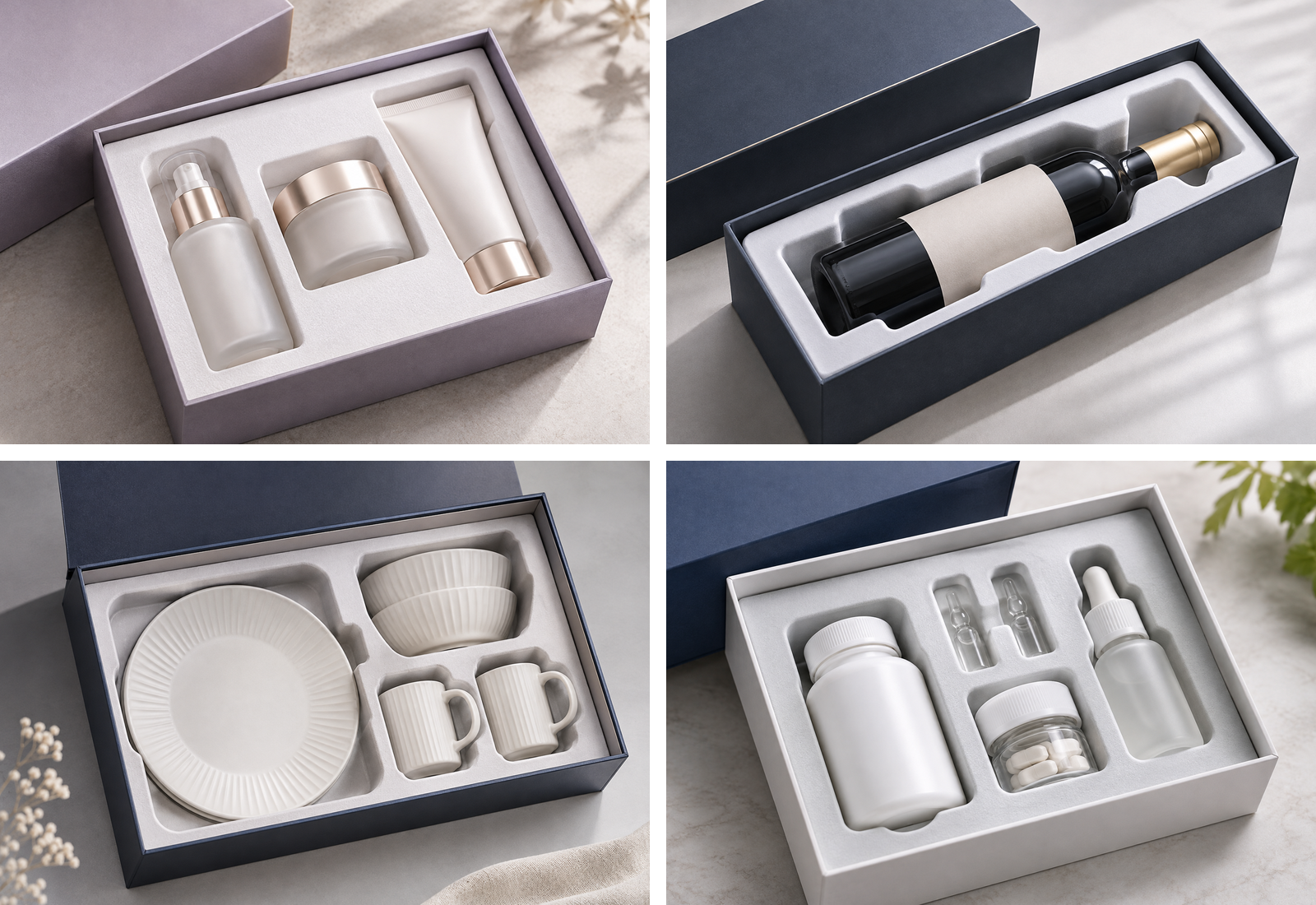
Glass, ceramics, and cosmetic products are fragile due to weak areas in their design. They can easily be damaged by knocks, resulting in cracks or breakages. Bottles can also be damaged by colliding with one another. As with electronic products, the same principles are applied, however the support features must be adapted to suit the product.
| Item | Fragility | Support design |
|---|---|---|
| Skincare & Cosmetic sets | Fragile areas include glass bottles, jars, lids, pumps and printed labels. | To prevent contact between products, separate cavities have been created for each item. A tray, drawer or lid can be placed around the items. Further examples of skincare packaging can be found here. |
| Wine & Spirits bottle | Fragile areas include the neck, shoulders, and label. | As this product is quite large in height to diameter ratio, a cavity has been developed to fit the shape of the bottle. The bottle sits securely in place within the cavity at the base and shoulders to prevent movement during transportation. |
| Glass & Ceramics Gift Sets | Fragile areas include the rims, handles, and thin walls. | Separate cavities prevent contact between products. There is support underneath the base. |
| Healthcare & Pharmaceutical products | Fragile items include vials, bottles, and devices. | Products have been placed in a ‘tight’ tray to ensure secure positioning. Further examples of pharmaceutical packaging can be found here. |
| Food & Beverage products | Fragile items include glass jars & bottles. | Separate cavities have been created. Items containing moisture or oils will be considered in advance (see section 08). |
Each product has its own designated area within the insert. The main cause of damage in fragile sets is if products collide with each other. By individually placing items within cavities, this issue can be solved. Using individual cavities also means that the package appears to be well thought out when opened.
Supports are added to the strongest part of the product. In bottles, this is the base and shoulders. In jars it is the base and body. The neck, lid and label are left without any load.
07. How Does the Insert Design Relate to the Outer Packaging?
The outer box protects against crushing forces and stacking forces. The insert just holds the item in place. If either of these components have been designed alone then issues may occur at the interface of both components.
The depth of the insert must match the rigidity of the outer box. If the insert is too deep, the lid of the outer box will not be flush. If the insert is too shallow, the item within will move. The depth of the insert has therefore been matched to the outer box. The outer edge of the insert has a raised edge to accept the force of the lid.
To fit into a corrugated box, the shape of the insert is important. A tight fitting insert prevents movement. If there is movement, ribs between the insert and carton walls can accommodate this.
The outer box is protecting against vertical forces. The rigid boxes or corrugated boxes are protecting against stacking and crushing forces. The insert is not required to do this.
Both the inserts and outer packaging are designed together. All components have been checked to fit together correctly during prototyping. Full information on how custom packaging projects are manufactured from specification to delivery can be found here.
08. When Is Moulded Pulp Not Appropriate?
Whilst moulded pulp can be used to protect many different products, it may not be suitable for all. It is important to understand the limitations of moulded pulp. If your product is approaching any limitations, we will advise you early in the design process.
| Situation | What to consider |
|---|---|
| Very heavy products | A heavy product puts more load on the insert. The wall structure may need to be stronger, or the outer box may need to take more of the load, or the pack may need a different structure. |
| Humid storage or transport | Pulp absorbs humidity from the air, which can soften and warp the part. We pack the parts dry and advise you to store them dry. If dampness cannot be avoided, tell us at the start. |
| Moist, oily or food related products | Water and oil resistant additives can be added to the fibre. This changes the blend and how the part is handled at end of life, so we need to know early. |
| Products that change size or shape | The cavity is built into the tooling. A change to the product after the tooling is made means altering or remaking the tooling. |
| Repeated hard knocks | An insert crushes to absorb a hit. Where a product will take repeated heavy impacts, the outer box and the handling method matter as much as the insert. |
None of these rule out moulded pulp. They are the reasons we ask for your product, your outer box and your shipping method at the start, so that the design is made for the real conditions and not an assumed one.
09. How Is Protection Verified with a Physical Sample?
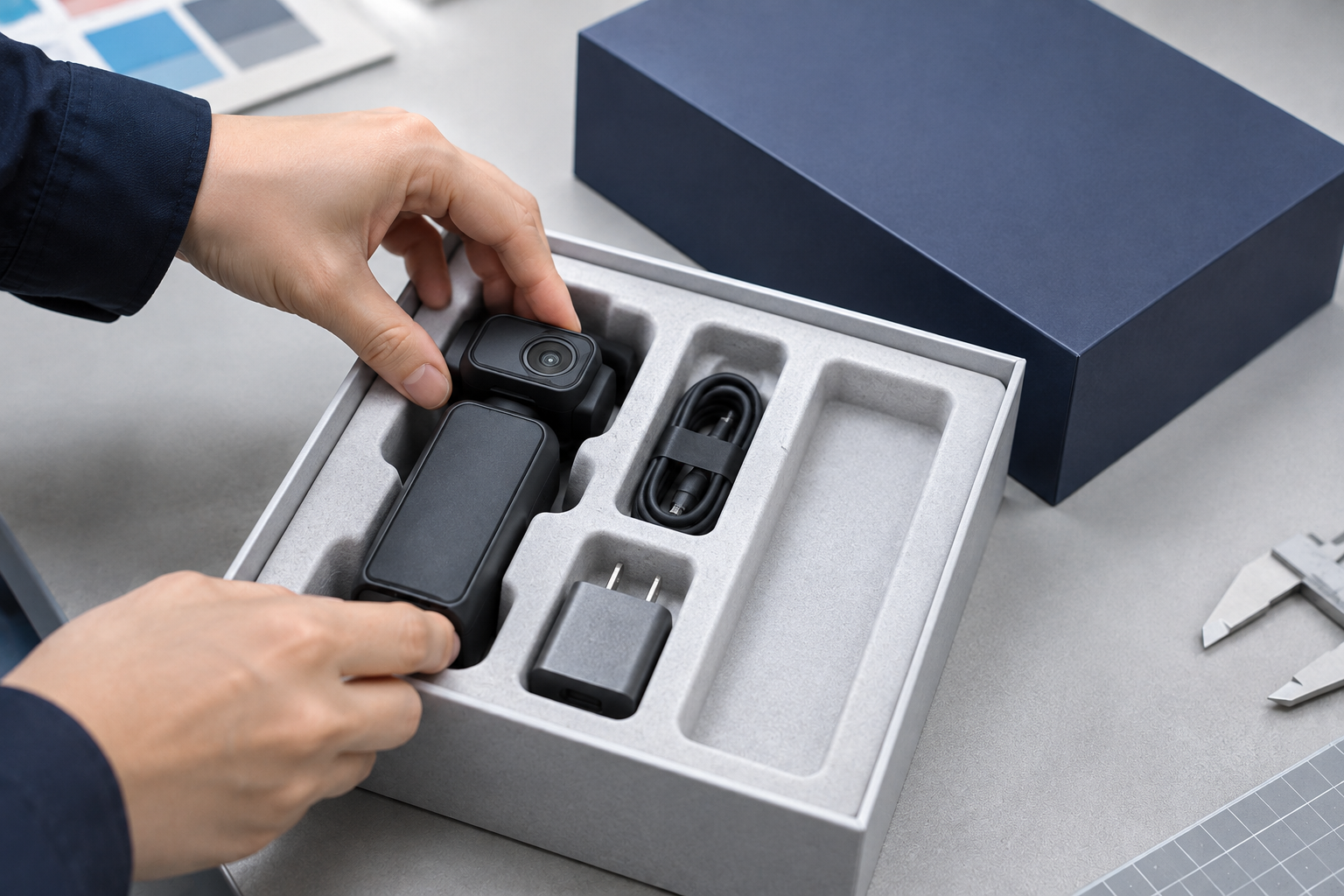
A drawing cannot show whether an insert protects a product. A physical sample can. We build one from the approved design, and nothing goes into production until you have approved it.
On the sample we check that the product seats firmly, with no rattle, and lifts out without force. Every cable, charger and leaflet has its own place and does not press on the product. The product should rest on its strong points, with the screens, lenses, necks and labels kept clear.
We also check that the rigid box lid closes flat, so the pressure falls on the rim and not on the product, and that the insert sits snugly in the carton or box with no shifting. We suggest you handle the sample the way the pack will be handled: pack it with your real product, tilt it, shake it gently, stack it and open and close it several times.
The checks also differ by type of product.
| Product | What is checked on the sample |
|---|---|
| Electronic devices | The screen does not touch the insert, and the lid presses on the flange and not on the glass. The camera housing, buttons and ports sit in their recesses. The cable and charger sit in their own channel and section. |
| Skincare and cosmetic sets | Each bottle or jar sits in its own cavity, with no contact between products. Lids, pumps and labels carry no load, and the tray, drawer or lid closes without pressing on the items. |
| Wine and spirits bottles | The bottle sits on its base and shoulders and does not move when the box is tilted. The neck and label carry no load. |
| Glass and ceramic gift sets | Every piece has its own cavity, with support underneath the base. Rims, handles and thin walls do not touch anything. |
| Healthcare and pharmaceutical products | Each vial, bottle or device is held in position by the tray, and nothing moves when the pack is handled. |
If the sample shows a problem, it is much easier to fix at this stage than after the tooling has been made. The full sequence is set out in our custom packaging manufacturing process: specification, product fit test, design, prototype, approval, production with colour check, and delivery.
It is worth trying the sample in the conditions your product will really meet. If you ship by courier, pack it as you would for a courier. If it goes on pallets, stack it as it will be stacked.
10. What Should You Send Us to Start?
The more we know about the product and the pack at the start, the closer the first prototype will be to the final. This is what we ask for.
- The product: the real product, or a sample, because its measurements rarely match the data sheet.
- The delicate areas: which parts of the product are fragile, such as screens, lenses, glass necks, lids and labels, so we know where the insert must not carry load.
- The weight: the weight of the product, because a heavier product needs more support and may need more help from the outer box.
- The accessories: cables, chargers, manuals and anything else that goes in the pack.
- The outer packaging: the rigid box, the corrugated carton or the dimensions you plan to use.
- Quantities: how many pieces you expect for each design, so we can confirm the minimum order quantity for the part.
- How it travels: courier, pallet, export or shelf, so we design for the real handling.
- Storage conditions: any humidity or storage concerns, so we can plan for them.
- Finish and branding: whether you want an embossed logo, and where it sits.
Cavity layout, wall angles, outer size and an embossed logo are all fixed once the tooling is made, so they need to be agreed before then. Ideally your lead time will be 3 to 6 weeks. A repeat order reuses the same tooling, so it can usually move faster. We confirm the minimum order quantity for your part once we have seen the product and the quantities.
11. Why Choose PT Print for Custom Moulded Pulp Packaging?
We make custom moulded pulp packaging for brands who need the inside of the pack to protect the product as well as present it. These are the reasons customers work with us.
- Wet press moulded pulp: we make wet press parts, with a smooth finish, thinner walls and sharper detail, suited to electronics, cosmetics and presentation packaging.
- Insert and outer box designed together: we also make rigid boxes, corrugated boxes and cardboard boxes, so the whole pack is planned as one.
- Over 40 years of packaging manufacturing: including packaging for electronics, cosmetics, pharmaceutical and food and beverage products.
- A tested prototype before production: nothing goes into production until you have approved the prototype.
- Fibre based material: our blend of bamboo, bagasse and old corrugated containers contains no virgin plastic, and moulded pulp can go into paper recycling where facilities exist. See our guide to sustainable packaging in Australia.
- Certified management systems: we hold ISO 9001 and ISO 14001.
12. Conclusion
Protective packaging inserts made from moulded pulp are designed, not just moulded. The cavity holds the product still, the walls and ribs absorb the shock, and the supports keep the fragile points clear, with the outer box carrying the load from above. Bring us the product, its accessories and the outer pack, and we will design the insert around them, prove it on a physical prototype, and confirm the fit before you approve anything.
Need an insert that protects your product?
Send us the product, its accessories and the pack it goes in, and we will confirm the insert design, prototype and timeline for your product.
Talk to Us About Your InsertFAQs
What makes protective packaging inserts made from moulded pulp effective?
A protective insert holds the product still in a cavity shaped to it, absorbs shock through its walls and ribs, and keeps the fragile points such as screens, lenses and glass necks clear of load. It is designed around the real product and the outer box, and confirmed on a prototype.
Is moulded pulp electronics packaging strong enough to protect a device?
Yes, for many electronic products. The insert is shaped to the device, holds it on its strong points and has ribs between the product and the box. Very heavy electronics may need extra support from the outer box, and we tell you early if that applies.
Can moulded pulp protect glass and other fragile products?
Yes. Each bottle, jar or glass piece gets its own cavity, so items do not touch each other, and the supports sit under the base and shoulder, with the neck and cap kept free of load. We confirm the fit on a prototype.
How do you design an insert for my product?
We start with your real product, its accessories and the outer box, then complete a product fit test. Once the fit is confirmed we design the insert, build a physical prototype and take your approval before production begins.
How do I check that the insert protects my product?
Pack the prototype with your real product and the outer box, then handle it the way the pack will be handled: tilt it, shake it gently, stack it and open and close the lid several times. Check for movement, marks and pressure on the fragile points.
Can moulded pulp be used for heavy products?
It depends on the weight and the shape. A heavy product puts more load on the insert, so the wall structure may need to be stronger, or the outer box may need to carry more of the load. Tell us the weight at the start and we will confirm what is suitable.
Does humidity affect moulded pulp inserts?
Yes. Pulp absorbs humidity from the air, which can soften and warp a part. We pack the parts dry, and storing them dry helps keep them in good condition. If your product is moist or oily, let us know so we can adjust the fibre blend.
Is wet press or dry press better for protective inserts?
Wet press gives a smooth surface, thinner walls and sharper detail, which suits electronics, cosmetics and presentation packaging. Dry press gives a rougher surface and thicker walls, which is often used for appliances and transit packaging. We make wet press moulded pulp.
What is the lead time, and is there a minimum order quantity?
Our lead time is ideally 3 to 6 weeks, depending on how quickly the specifications and design are confirmed and whether it is a first run or a repeat order. There is a minimum order quantity for moulded pulp, and we confirm it for your project once we know the part.